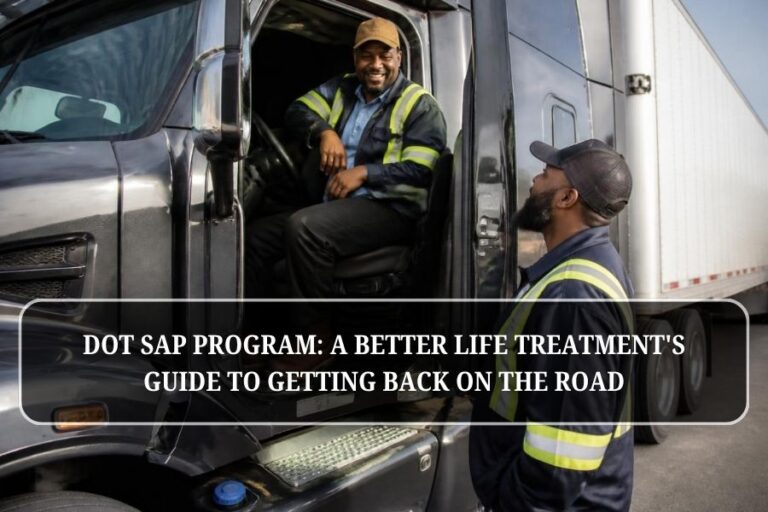
Commercial drivers keep America moving. Truckers, bus operators, and CDL holders carry public safety on their shoulders every shift. That’s why the Department of Transportation enforces tight rules around drug and alcohol use.
Break one of those rules, and a driver can’t return to safety-sensitive work until they finish the DOT Substance Abuse Professional (SAP) Program. It’s the federal checkpoint that confirms a driver is ready to get back behind the wheel responsibly.
A Better Life Treatment runs one of the fastest, most affordable Virtual DOT SAP Programs in the country. Our SAP professionals guide drivers through evaluation, education, and return-to-duty all online, start to finish.
What Is the DOT SAP Program?
It’s the federally required path drivers take after a DOT drug or alcohol violation. The goal isn’t punishment; it’s making sure any underlying issue is addressed before someone climbs back into a commercial vehicle.
A Substance Abuse Professional is a DOT-trained clinician who handles the whole arc:
● Runs the initial evaluation
● Recommends education or treatment
● Tracks progress through that program
● Conducts the follow-up evaluation
● Determines when the employee has successfully complied with the recommendations and is eligible for Return-to-Duty testing
The Federal Motor Carrier Safety Administration (FMCSA) sets the rules here. Drivers can check the details directly on the FMCSA Clearinghouse site.
What Happens in a Virtual SAP Evaluation?
This is step one of the return-to-duty road, done remotely over secure telehealth. The SAP professional looks at:
● The violation itself
● Substance use history
● Behavioral health factors
● Any risk signals tied to drug or alcohol use
From there, they recommend what’s actually needed: education, counseling, outpatient care, or, in tougher cases, residential treatment. Nothing more, nothing less than what fits the situation.
A Better Life Treatment handles these evaluations nationwide, entirely virtual, so drivers can get moving on day one instead of waiting weeks for an appointment.
Why the SAP Program Exists
DOT triggers a mandatory SAP process for violations like:
● A positive drug test
● A positive alcohol test
● Refusing a scheduled test
● Tampering with a test
● No-showing a scheduled test
Any one of these pulls a driver off safety-sensitive duty immediately. The SAP Program is the only way back, and it protects the driver as much as the public.

The FMCSA Clearinghouse, Explained
Think of the Clearinghouse as the national record book for DOT drug and alcohol violations. Employers, SAP professionals, and medical review officers all report and check activity here.
Before a driver can even start the SAP process, they need to register in the Clearinghouse and pick their SAP professional.
What is the Return-to-Duty Process?
1. Initial Evaluation
A Qualified SAP reviews the violation and decides what’s required next: education, treatment, or both. We run this virtually, so there’s no travel and no waiting room.
2. Education or Treatment
Based on the evaluation, the SAP recommends a path: education classes, counseling, or a treatment program. The SAP determines the appropriate education and/or treatment based on the individual’s clinical assessment and circumstances.
3. Completion & Documentation
The driver finishes the assigned program and submits proof of completion to their SAP.
4. Follow-Up Evaluation
The SAP conducts a follow-up evaluation to determine whether the driver has successfully complied with the education and/or treatment recommendations. If so, the SAP reports the driver’s eligibility for Return-to-Duty testing to the Clearinghouse.
5. Return-to-Duty Test
The employer then sends the driver for the required Return-to-Duty test. The driver must receive a negative drug test result and/or an alcohol test result below 0.02 before resuming safety-sensitive duties.
6. Follow-Up Testing
After returning to safety-sensitive duties, the driver is subject to a SAP-prescribed follow-up testing plan. DOT rules require at least six unannounced follow-up tests during the first 12 months of safety-sensitive duty. The SAP may require additional testing for up to five years.
Why Drivers Pick A Better Life Treatment
A slow or expensive SAP provider can stall a driver’s paycheck for months. We built our program to avoid exactly that.
What sets us apart:
● Fast-tracked virtual scheduling
● Transparent, affordable pricing
● Nationwide coverage
● Experienced, DOT-qualified SAP staff
● Clear guidance at every stage, no guesswork
Speed Without Cutting Corners
A lot of drivers assume SAP means months on the sidelines. It doesn’t have to. We move fast by:
● Booking evaluations quickly
● Giving clear, upfront instructions for any required program
● Tracking progress closely instead of letting cases sit
● Filing reports the moment they’re ready
Affordable, Without the Hidden Fees
SAP programs can rack up costs fast: evaluations, counseling, and follow-ups may each involve separate costs. A Better Life Treatment keeps pricing simple and low, without skipping any federally required step.
Built for CDL Drivers Anywhere
Wherever a driver is based, our telehealth model makes the SAP evaluation and follow-up evaluation accessible without traveling to our office.
Frequently Asked Questions
How long does this take?
Depends on what the SAP recommends. Some drivers wrap up in a few weeks; others with longer treatment needs take more time.
Can I pick my own SAP?
Yes, you choose your SAP professional when you register in the Clearinghouse.
Is the evaluation really done online?
Yes, through secure telehealth, within DOT guidelines.
What if I skip the program?
Until the SAP process is successfully completed, the driver cannot return to DOT-regulated safety-sensitive duties.
Ready to Start?
Got a DOT violation on your record? The clock starts the moment you begin your SAP evaluation, so start now.
A Better Life Treatment offers drivers nationwide a faster, cheaper way through the Virtual DOT SAP process. Visit us to schedule your evaluation, and we’ll walk you through every step from there.