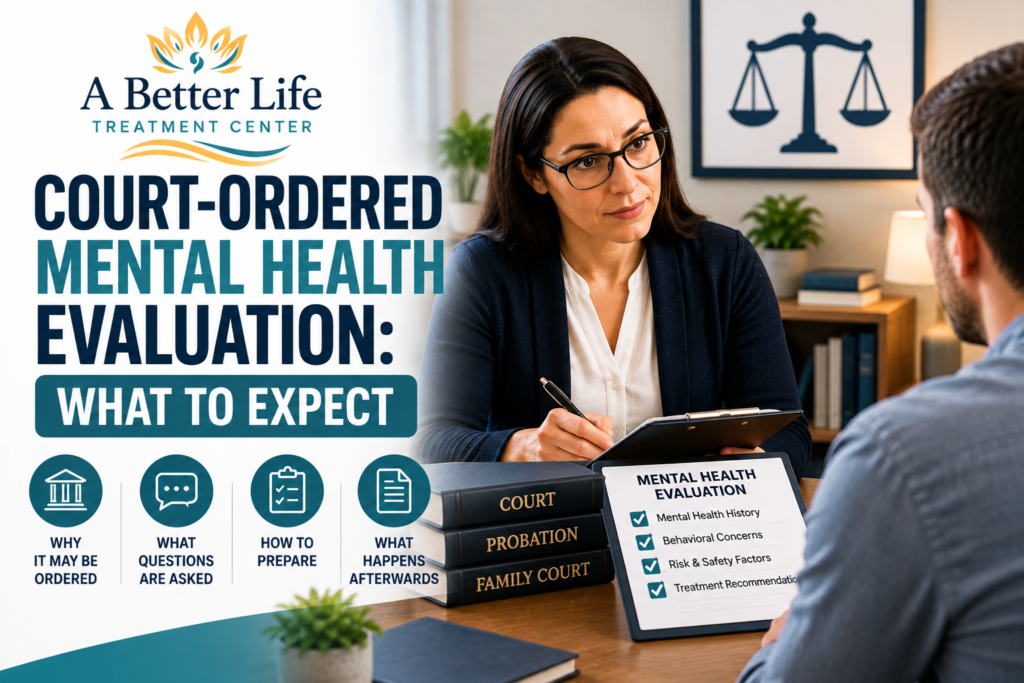
Court-Ordered Mental Health Evaluation: What to Expect
If a judge, probation officer, attorney, or family court has told you to complete a
court-ordered mental health evaluation, you may have questions about
what the evaluator will ask and what happens with the results.
A mental health evaluation is designed to help a qualified professional understand
your emotional health, behavior, personal history, current concerns, and treatment needs.
It is not simply a test that you pass or fail.
This guide explains why courts may request mental health evaluations, what happens
during the appointment, how to prepare, and what may happen afterward.
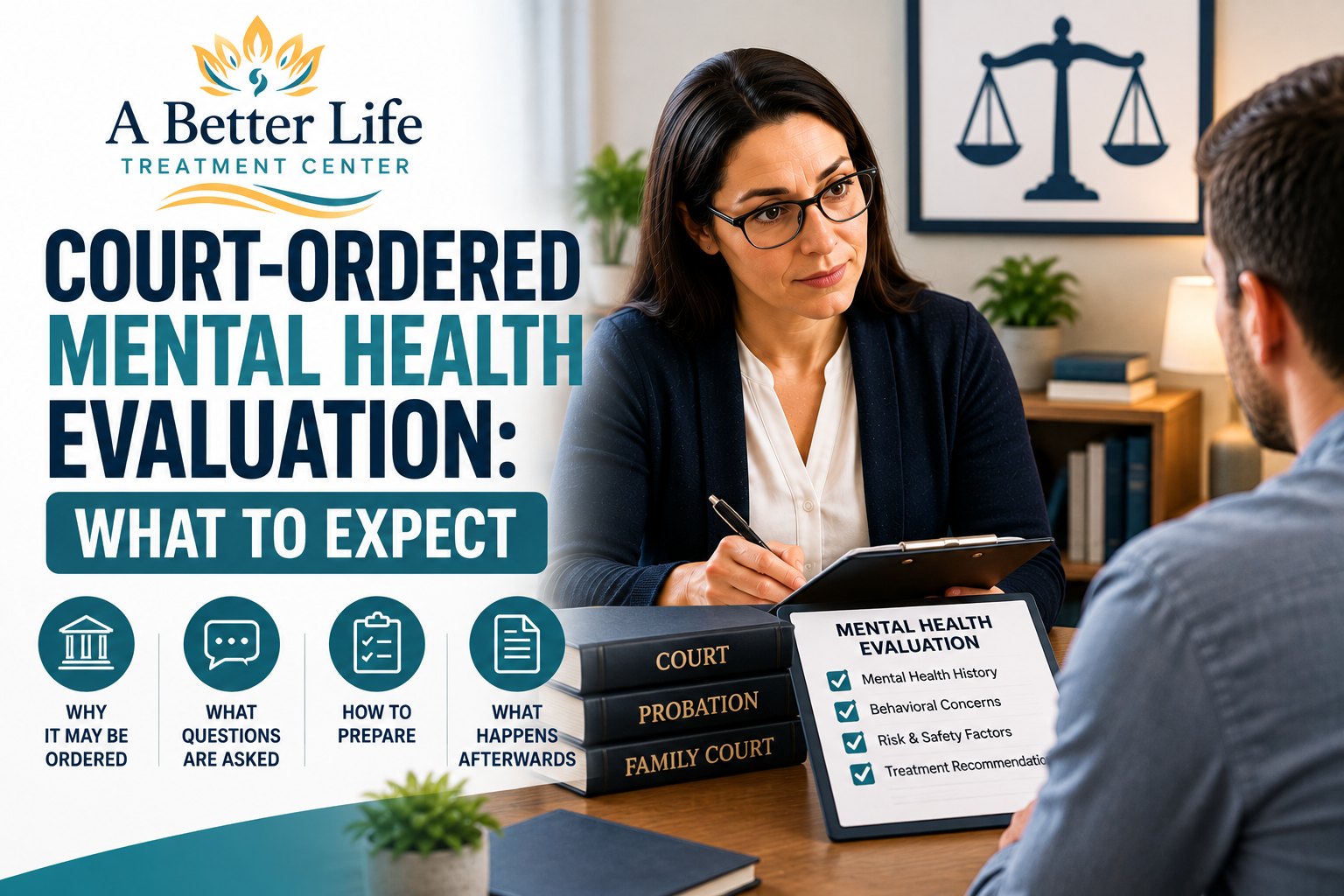
behavioral, and mental health concerns.
Key Takeaways
- A court-ordered mental health evaluation is generally an assessment, not a pass-or-fail test.
- The evaluator may ask about mental health, behavior, relationships, substance use, and treatment history.
- Bring your court order, probation instructions, or attorney paperwork.
- The evaluator may make recommendations based on the information gathered.
- A report or other documentation may need to be provided to the referring party.
What Is a Court-Ordered Mental Health Evaluation?
A court-ordered mental health evaluation is a professional assessment
used to better understand a person’s emotional health, behavior, psychological concerns,
personal history, and possible need for counseling or treatment.
The evaluation may be requested by a criminal court, family court, probation officer,
attorney, or another legal authority.
However, the exact purpose depends on the case.
Therefore, the evaluator should review the referral paperwork before beginning the assessment.
Why Would a Court Require a Mental Health Evaluation?
Courts may request mental health evaluations for many different reasons.
Usually, the goal is to obtain professional information that may help address concerns related
to behavior, emotional health, safety, treatment, or compliance.
Common situations may include:
- Criminal court cases
- Probation requirements
- Pretrial or diversion programs
- Child custody or family court matters
- Domestic or family conflict cases
- Behavioral concerns
- Attorney-requested evaluations
- Professional or licensing matters
Still, every case is different.
A mental health evaluation ordered for probation may have different requirements
from one requested during a family court matter.
Bring or send your court order, attorney letter, or probation paperwork before your appointment.
The documents can help the provider understand exactly what is being requested.
What Happens During a Court-Ordered Mental Health Evaluation?
The evaluation usually begins with a professional interview.
First, the evaluator may explain the process and review why you were referred.
Next, you may discuss your background and current concerns.
The evaluation may include:
- Personal and family history
- Mental health history
- Current emotional concerns
- Behavioral concerns
- Medical history
- Current medications
- Prior counseling or treatment
- Alcohol or drug use
- Legal history
- Work and relationship concerns
- Standardized screening tools, when appropriate
The evaluator may also review records provided by the court, attorney,
probation officer, or other referring party.
What Questions Are Asked During a Mental Health Evaluation?
The exact questions depend on the reason for the evaluation.
However, most evaluators need to understand both your past and your current situation.
You may be asked questions such as:
- Why were you asked to complete the evaluation?
- Have you received mental health treatment before?
- Have you ever been diagnosed with a mental health condition?
- Are you currently taking any medications?
- Have you experienced anxiety, depression, anger, or significant stress?
- How have you been sleeping?
- Have your emotions affected work, school, or relationships?
- Have you experienced major changes or stressful events recently?
- Do you use alcohol or drugs?
- What support systems do you currently have?
Depending on the referral, the evaluator may also ask questions about the incident
or behavior that led to the court order.
Should You Be Honest During the Evaluation?
Yes. Accurate information helps the evaluator understand your situation and make
an appropriate recommendation.
Some people worry that discussing symptoms will automatically lead to a diagnosis
or treatment recommendation. That is not necessarily the case.
Instead, the evaluator considers the full picture.
Therefore, it is usually better to answer questions honestly rather than trying
to determine what you think the evaluator wants to hear.
Answer honestly, ask for clarification when you do not understand a question,
and provide relevant records when requested.
Can You Fail a Court-Ordered Mental Health Evaluation?
A mental health evaluation is generally not designed as a traditional pass-or-fail test.
Instead, the evaluator gathers information and develops professional findings or recommendations.
Possible outcomes may include:
- No additional clinical services recommended
- Individual counseling
- Anger management services
- Mental health treatment
- Substance abuse evaluation or treatment
- Additional psychological assessment
- Follow-up services or monitoring
The court may also have requirements that are separate from the evaluator’s clinical recommendations.
How Long Does a Court-Ordered Mental Health Evaluation Take?
Many mental health evaluations can be completed in one appointment.
However, the amount of time depends on the purpose and complexity of the evaluation.
Some appointments may take about an hour.
Others may require more time, additional records, screening tools, or follow-up.
A written report may also take additional time after the interview is complete.
Therefore, schedule early if you have a court deadline.
Can a Court-Ordered Mental Health Evaluation Be Completed Online?
In some situations, a mental health evaluation may be completed through a secure virtual appointment.
However, acceptance varies by court, probation office, jurisdiction, and type of evaluation.
Therefore, confirm whether a virtual evaluation is acceptable before scheduling.
If you are unsure, provide your referral paperwork to A Better Life Treatment so the requirement
can be reviewed before your appointment.
How to Prepare for Your Mental Health Evaluation
Preparing ahead of time can make the evaluation easier and help prevent delays.
Before your appointment:
- Gather your court order or referral paperwork.
- Bring probation instructions, if applicable.
- Provide attorney correspondence related to the evaluation.
- Make a list of current medications.
- Gather relevant treatment or counseling records if requested.
- Know your court date or deadline.
- Confirm who should receive the completed documentation.
- Complete intake paperwork before the appointment when possible.
Also, arrive on time or log in early for a virtual appointment.
Is a Court-Ordered Mental Health Evaluation Confidential?
Mental health information is generally treated as private.
However, a court-ordered evaluation is different from ordinary private therapy.
Information or a report may be provided to the court, probation officer, attorney,
or another authorized party depending on the referral and applicable requirements.
Therefore, ask the evaluator to explain who may receive information from the assessment
before the evaluation begins.
What Happens After the Mental Health Evaluation?
After the appointment, the evaluator reviews the information gathered during the assessment.
If required, the evaluator may prepare findings, recommendations, or documentation.
Possible recommendations may include:
- No further clinical services
- Individual counseling
- Family counseling
- Anger management
- Substance abuse services
- Mental health treatment
- Additional assessment
- Other appropriate follow-up services
Recommendations depend on the individual and the purpose of the evaluation.
Therefore, not everyone receives the same outcome.
Will the Court Receive the Mental Health Evaluation?
If the evaluation was ordered by the court, some form of documentation may need to be submitted.
However, do not assume the provider automatically knows where to send it.
Before leaving your appointment, confirm:
- Whether a report is required
- Who should receive it
- Whether your attorney needs a copy
- Whether probation needs documentation
- Your submission deadline
- Whether you need to submit anything yourself
Confirm that all required documentation has been completed and submitted to the correct recipient.
Is a Mental Health Evaluation the Same as Therapy?
No. An evaluation and therapy serve different purposes.
An evaluation gathers information and helps identify possible concerns or recommendations.
Therapy focuses on ongoing treatment and support.
As a result, completing an evaluation does not necessarily mean you will need ongoing counseling.
Treatment is recommended when appropriate based on the assessment and referral requirements.
FAQ: Court-Ordered Mental Health Evaluations
What is a court-ordered mental health evaluation?
It is a professional assessment requested by a court or other legal authority to evaluate
mental health, emotional well-being, behavior, personal history, and possible treatment needs.
Can you fail a court-ordered mental health evaluation?
Mental health evaluations are generally not pass-or-fail tests.
The evaluator gathers information and may provide findings or recommendations based on the assessment.
What questions are asked during a mental health evaluation?
Questions may cover mental health history, current symptoms, medications, relationships,
work, family, substance use, treatment history, stress, and the reason for the referral.
How long does a court-ordered mental health evaluation take?
Many evaluations can be completed in one appointment.
More complex evaluations may require additional time, records, testing, or follow-up.
Does a mental health evaluation mean I have a mental illness?
No. Being asked to complete an evaluation does not automatically mean that you have a mental health condition.
The purpose of the evaluation is to assess the situation professionally.
Will I automatically be required to attend therapy?
No. Counseling or treatment may be recommended when appropriate,
but not everyone who completes a mental health evaluation receives the same recommendation.
Can the evaluation be completed online?
Virtual evaluations may be available in some situations.
Confirm that the referring court, probation office, or agency accepts a virtual evaluation before scheduling.
Will the court see my mental health evaluation?
The court or another authorized party may receive documentation when the evaluation is court ordered.
Ask the evaluator to explain who will receive information from the assessment.
What should I bring to my evaluation?
Bring your court order, probation instructions, attorney paperwork, medication information,
requested treatment records, deadline, and report recipient information.
Schedule a Court-Ordered Mental Health Evaluation
If you need a mental health evaluation for court, probation, an attorney,
family court, or another legal requirement, A Better Life Treatment can help you
understand the evaluation process and next steps.
Have your referral paperwork available when you contact us.
This helps our team understand what type of evaluation and documentation you need.